
Warren grew up near the Saline River in southeast Arkansas. Hugh Bradley and his party settled east of the future town around 1825. When the Legislature created Bradley County in 1840, the county court met at Bradley’s home, and in 1842 a new county seat was laid out on 40 donated acres. How Warren got its name is disputed: a 2015 courthouse time capsule and local family tradition point to Warren Bradley, a man Hugh Bradley enslaved, while the Encyclopedia of Arkansas also cites evidence for Bradley’s friend Edward Allen Warren, a Camden lawyer and congressman.
The railroad reached Warren in 1880, and big lumber mills followed around 1900. Farmers began shipping pink tomatoes in 1923, and the town has held its Pink Tomato Festival since 1956. This page collects dated photos, maps and public records from that history, with a link to every source.
Maps through the years
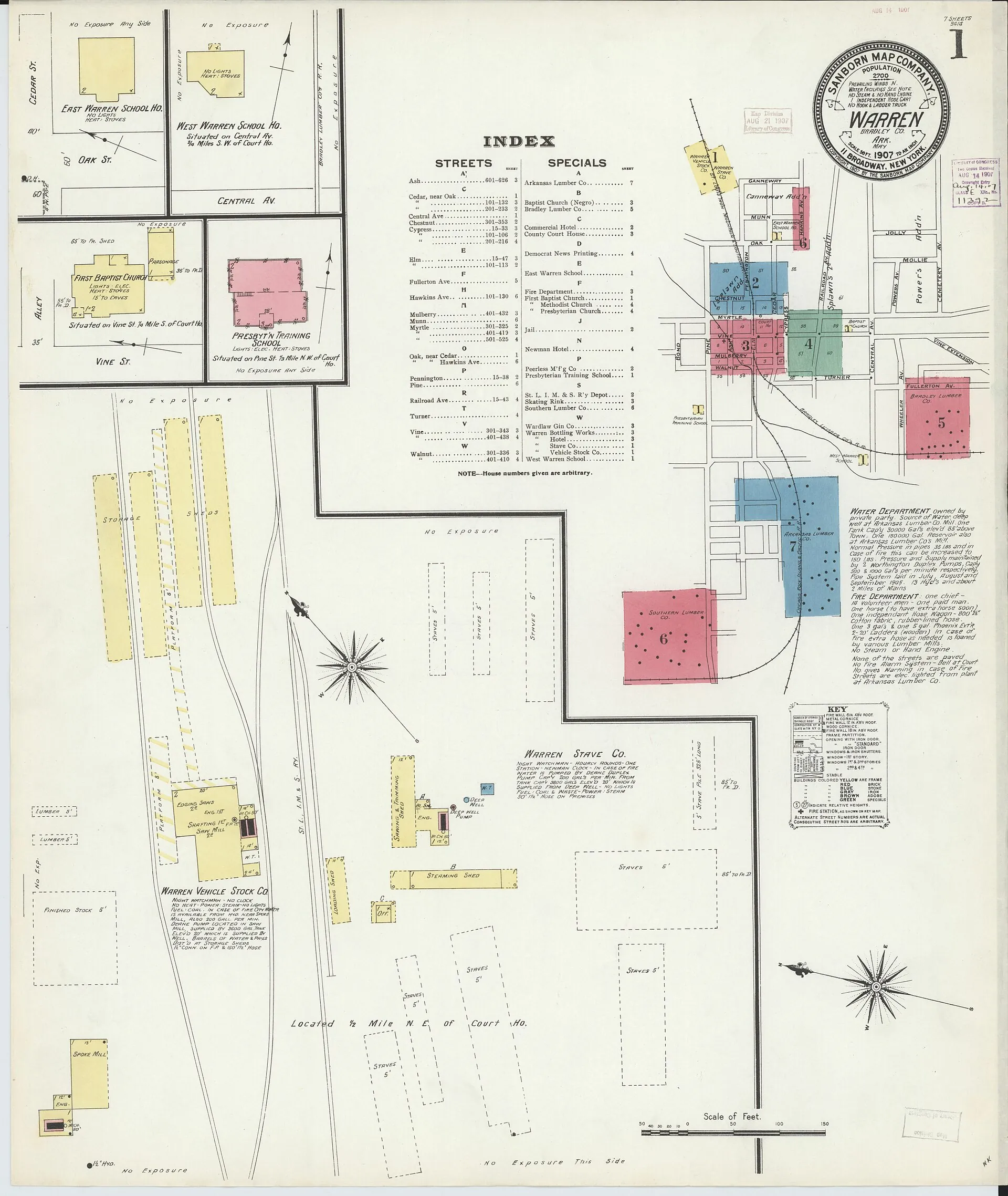
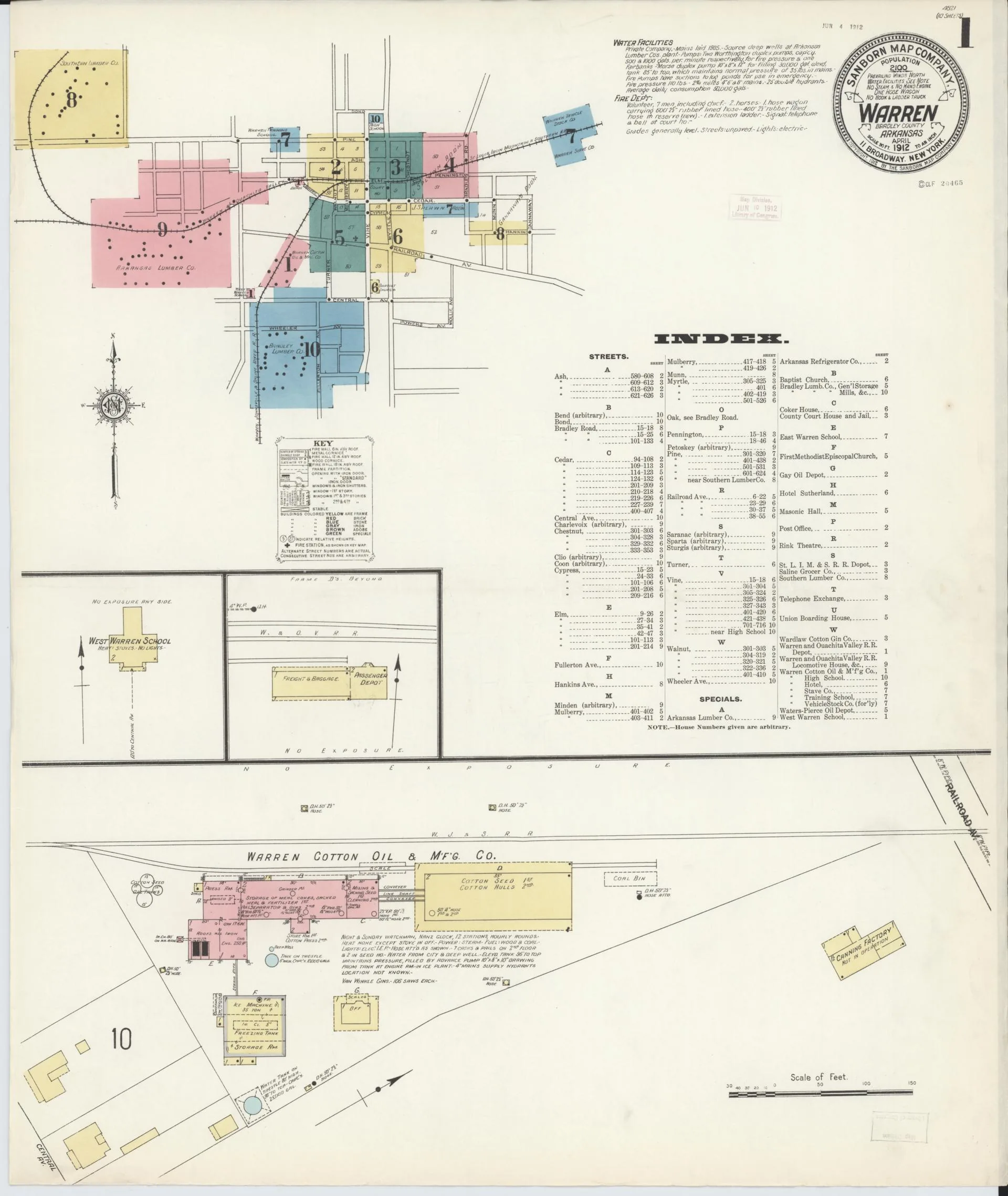
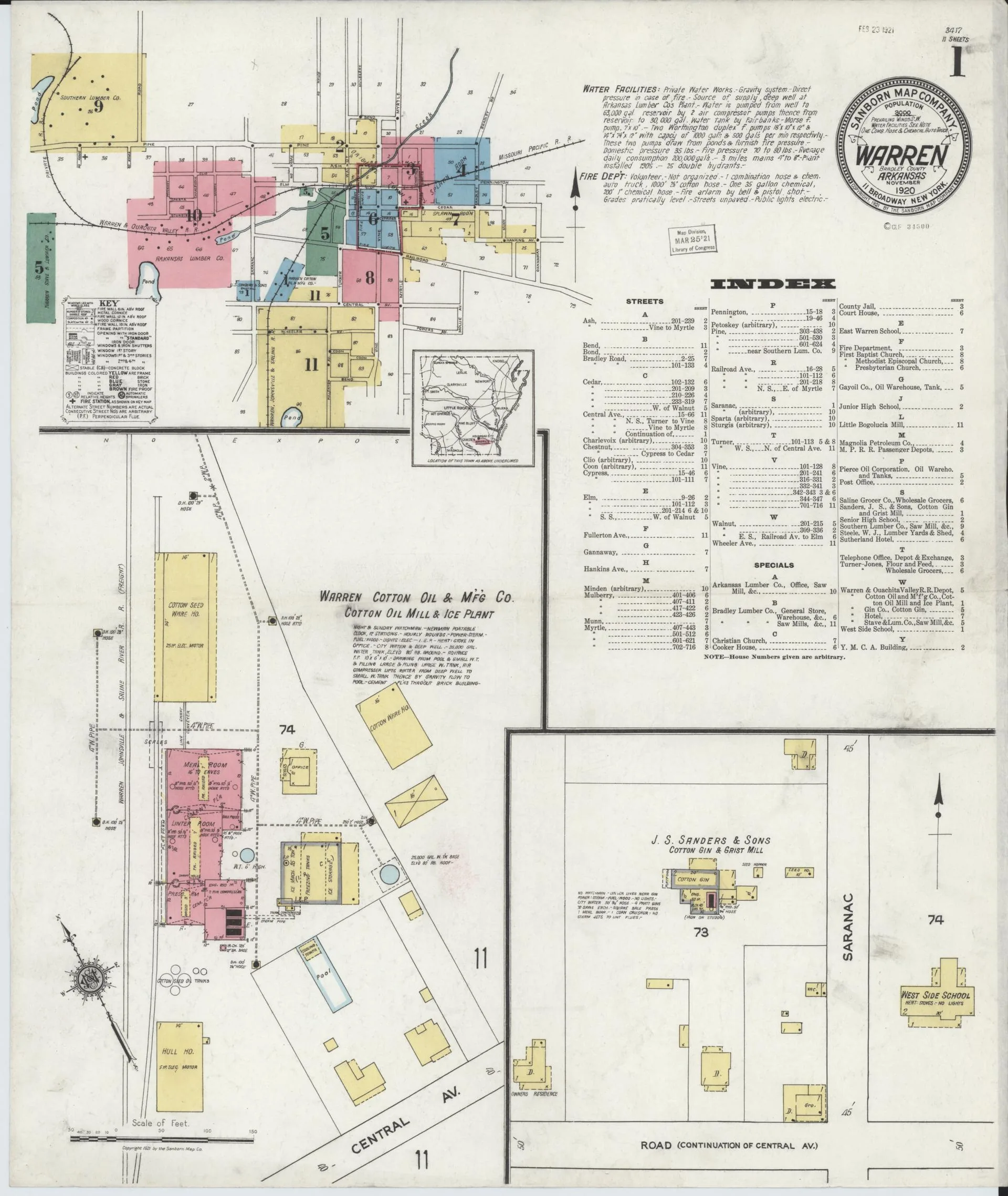
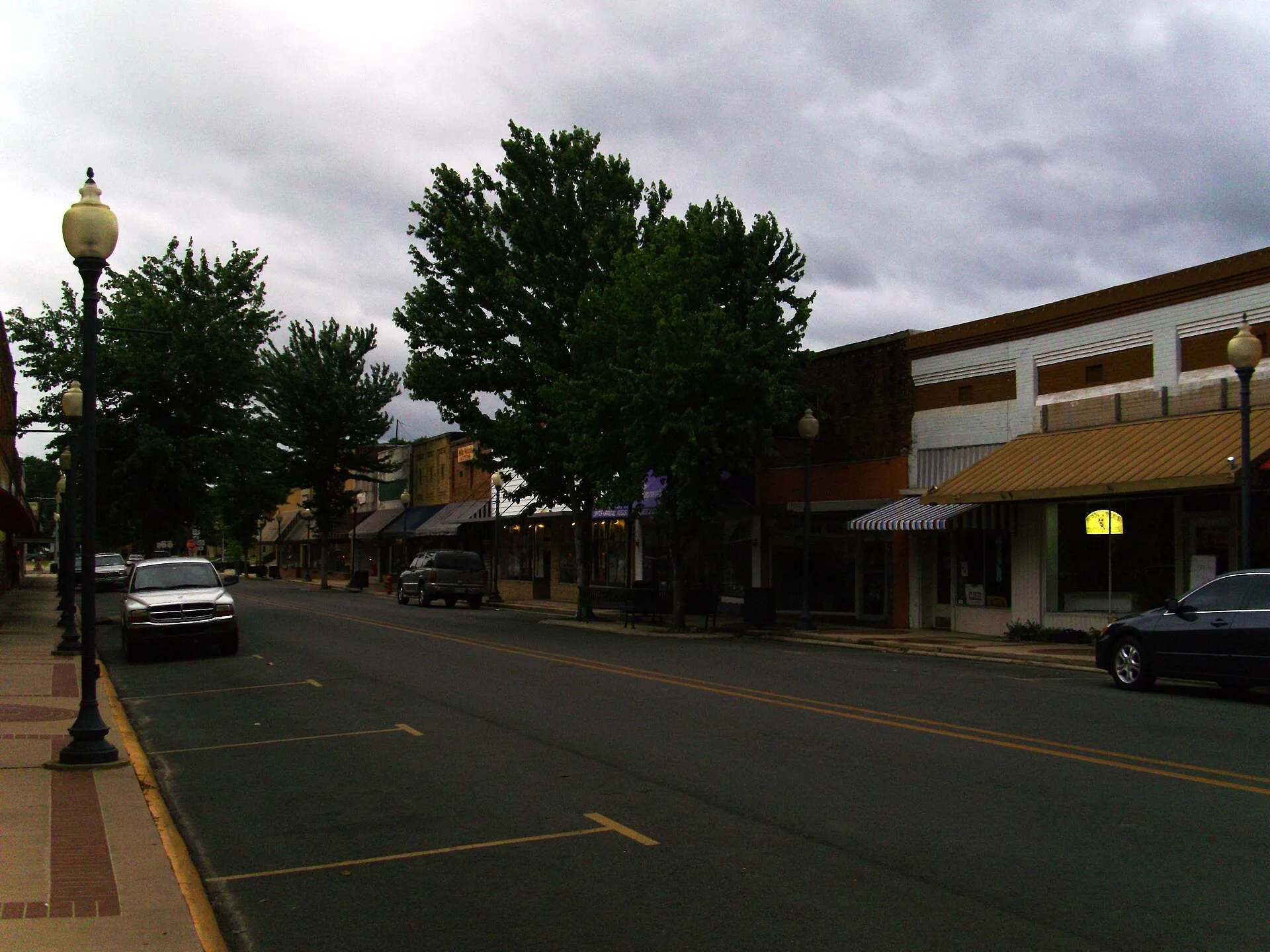
Sanborn fire insurance maps show Warren building by building: pink for brick, yellow for frame. Here is the first sheet of each edition in the Library of Congress collection, from 1907 to 1920, followed by a recent photo. Swipe or scroll sideways to see them all, and select a map to open it full size.
May 1907
April 1912
November 1920
Now, 2014

Business and industry
- Cotton town: In 1890, Goodspeed reported that Warren shipped about 6,000 bales of cotton a year and had a steam gin and grist mill and the incorporated Merchants & Planters Bank. The Warren News, published by John H. Page, was then the only newspaper in the county. Goodspeed, Biographical and Historical Memoirs of Southern Arkansas (1890)
- Fair: The South Arkansas Fair Association, organized in 1887, held its annual fair at Warren on grounds about half a mile from the square, according to Goodspeed. Goodspeed, Biographical and Historical Memoirs of Southern Arkansas (1890)
- Lumber mills: By 1941 the WPA guide called Warren one of Arkansas’s leading lumber towns. It said the Bradley Lumber Company mill at Wheeler Avenue and Martin Street employed about 1,100 workers in five units, including a hickory products department and a flooring plant, paid in cash and did not require workers to live in company houses or trade at the company store. The Southern Lumber Company mill at the west end of Pine Street employed about 400. Arkansas: A Guide to the State (Writers' Program, WPA, 1941)
- 1935 strike: After the U.S. Supreme Court struck down the National Recovery Act in 1935, about 500 Warren mill workers were idle for more than a month after an unsuccessful demand for union recognition, according to the WPA guide. Arkansas: A Guide to the State (Writers' Program, WPA, 1941)
Landmarks
- Bradley County Courthouse and Clerk's Office, courthouse square: The 1903 courthouse by Frank W. Gibb and the 1890 county clerk’s building. Listed on the National Register in 1976. National Register file
- Warren Commercial Historic District: About ten blocks of downtown around the courthouse square, with buildings from 1890 to 1966. Listed in 2016. National Register file
- Warren Brick Streets: Brick streets laid around 1927 on parts of Cedar, Myrtle, Chestnut, First, Walnut, Elm and Cypress streets. Listed in 2007. National Park Service
- Warren and Ouachita Valley Railway Station, 325 W. Cedar St.: Its National Register record gives key years of 1909 and 1911. Listed in 1977. National Park Service
- Warren Post Office, 236 S. Main St.: A Colonial Revival post office with design credited to Louis A. Simon; its National Register record gives a key year of 1935. Listed in 2004. National Park Service
- Blankinship Motor Company Building, 120 E. Cypress St.: Listed in 2001. National Park Service
- New Zion AME Zion Church, Myrtle and Neely streets: Listed in 2000. National Park Service
- St. Luke's Catholic Church, 508 W. Pine St.: Listed in 1998. National Park Service
- Historic houses: Bailey House, 302 Chestnut St. (listed 1975); Adams-Leslie House, south of town (1979); Ederington House, 326 S. Main St. (1984); Dr. John Wilson Martin House, 200 Ash St. (1990); Davis-Adams House, 509 N. Myrtle St. (1999); Wilson-Martin House, 511 Bond St. (2006). National Register database
Notable people
- Josiah Gould: Lawyer, circuit judge and longtime state senator from Warren. In 1858 he wrote the first digest of Arkansas statutes, known as “Gould’s Digest.” Encyclopedia of Arkansas
- John Milton Bradley: Confederate colonel of the Ninth Arkansas, listed among Warren’s famous residents. Encyclopedia of Arkansas
- John Lipton: State highway commissioner and speaker of the Arkansas House of Representatives, listed among Warren’s famous residents. Encyclopedia of Arkansas
Last checked Oct. 18, 2026.
Key facts
- Warren is the county seat of Bradley County, which the Legislature created on Dec. 18, 1840. (Source: National Register nomination, Bradley County Courthouse)
- The Bradley County Courthouse, built in 1903, is the third courthouse on Warren's square. The small brick county clerk's building beside it dates to 1890. (Source: National Register nomination, Bradley County Courthouse)
- Warren's Pink Tomato Festival began in 1956. (Source: National Register nomination, Warren Commercial Historic District)
- The Equal Justice Initiative documents 4 racial terror lynchings of Black people in Bradley County between 1877 and 1950. EJI counts only cases it could document, so the figure is a minimum. (Source: Equal Justice Initiative, Lynching in America county data (updated November 2024))
- In 1941 the Bradley Lumber Company mill in Warren employed about 1,100 workers, according to the WPA guide to Arkansas. (Source: Arkansas: A Guide to the State (Writers' Program, WPA, 1941))
Timeline
c. 1825
Hugh Bradley settles on the Saline River
Capt. Hugh Bradley and his party settle near the Saline River, east of where Warren is today.
Early settlers
Isaac Pennington and Aaron Johnston settle near the Saline River, east of the future site of Warren, according to Goodspeed.
Church and schoolhouse
A church and schoolhouse are built about two and a half miles east of where Warren later stood, according to Goodspeed.
Bradley County is created
The Legislature forms Bradley County and names it for Hugh Bradley. It first covers land that is now part of Cleveland, Lincoln, Ashley and Drew counties.
First county court
The first county court meets at Bradley's home. Commissioners pick a site for a county seat, and John H. Marks and John Splawn donate 40 acres for the town.
Warren is laid out
The town is laid out on the donated land. How it got its name is disputed. An 1890 county history cited in the downtown National Register nomination, local family tradition and a time capsule found in the courthouse in 2015 point to Warren Bradley, a man enslaved by Hugh Bradley. The Encyclopedia of Arkansas says there is also evidence it was named for Bradley's friend Edward Allen Warren, a Camden lawyer and U.S. representative.
First courthouse
A log courthouse with a fireplace at each end is built on today's courthouse square.
1858–1862
Brick courthouse
A two-story brick courthouse covered in stucco is started in 1858 and finished in 1862 at a cost of $7,498.
The railroad arrives
Warren becomes the western end of the Ouachita Division of the Little Rock, Mississippi River and Texas Railroad. Small lumber mills spring up across the county in the 1880s. The St. Louis, Iron Mountain and Southern takes over the line in 1887, and it becomes part of the Missouri Pacific in 1917.
South Arkansas Fair Association
The South Arkansas Fair Association is organized and begins holding its annual fair at Warren, according to Goodspeed.
A cotton market
Goodspeed reports that Warren ships about 6,000 bales of cotton a year and has a steam gin and grist mill, the Merchants & Planters Bank and the Warren News, the only paper in the county.
c. 1900
The big lumber mills
Northern lumbermen buy timber and start the Southern Lumber Company, the Arkansas Lumber Company and the Bradley Lumber Company of Arkansas. The three mills shape Warren's economy for decades.
Today's courthouse
The third courthouse on the square is built, designed by Little Rock architect Frank W. Gibb with E. L. Koonce as contractor.
YMCA chartered
The Warren YMCA receives its charter. Its first building burns in 1944 and is replaced.
Pink tomatoes go to market
Bradley County farmers first sell pink tomatoes commercially, as cotton becomes less profitable.
c. 1927
Brick streets
The city lays brick streets downtown as more people drive cars.
Mill workers idle
After the National Recovery Act is struck down, about 500 Warren mill workers are idle for more than a month after an unsuccessful demand for union recognition, according to the WPA guide.
Two big mills
The WPA guide reports about 1,100 workers at the Bradley Lumber Company mill and about 400 at the Southern Lumber Company mill.
The 1949 tornado
A tornado strikes the southern part of town at about 5:45 p.m. and wrecks hundreds of homes and much of the Bradley Lumber Company.
First Pink Tomato Festival
Warren holds its first Pink Tomato Festival.
Potlatch arrives
Potlatch merges with the Southern Lumber Company, and around 1958 it buys the Bradley Lumber Company, giving it control of more than 100,000 acres of Arkansas timberland.
Second tornado
Another tornado hits much of the same area.
State fruit
The Arkansas General Assembly names the South Arkansas Vine Ripe Pink Tomato the state fruit.
Downtown joins the National Register
The Warren Commercial Historic District, about ten blocks around the courthouse square, is listed on the National Register of Historic Places.
Photos
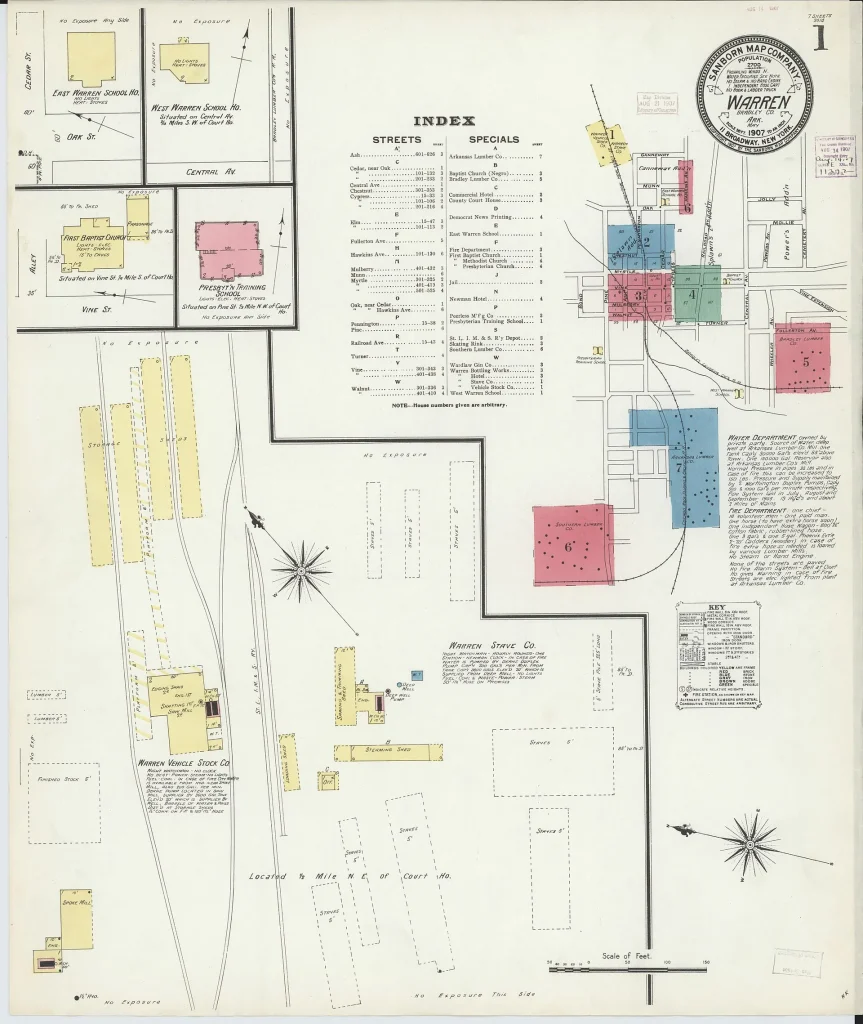
Index sheet of the May 1907 Sanborn fire insurance map of Warren. Photo: Library of Congress, Geography and Map Division, Sanborn Maps Collection, May 1907. Public domain (per Library of Congress). Source 
Postcard of the YMCA in Warren. Photo: Tichnor Brothers postcard #82473, Boston Public Library, Tichnor Brothers Collection, c. 1930–1945. No known copyright restrictions (per Boston Public Library). Source 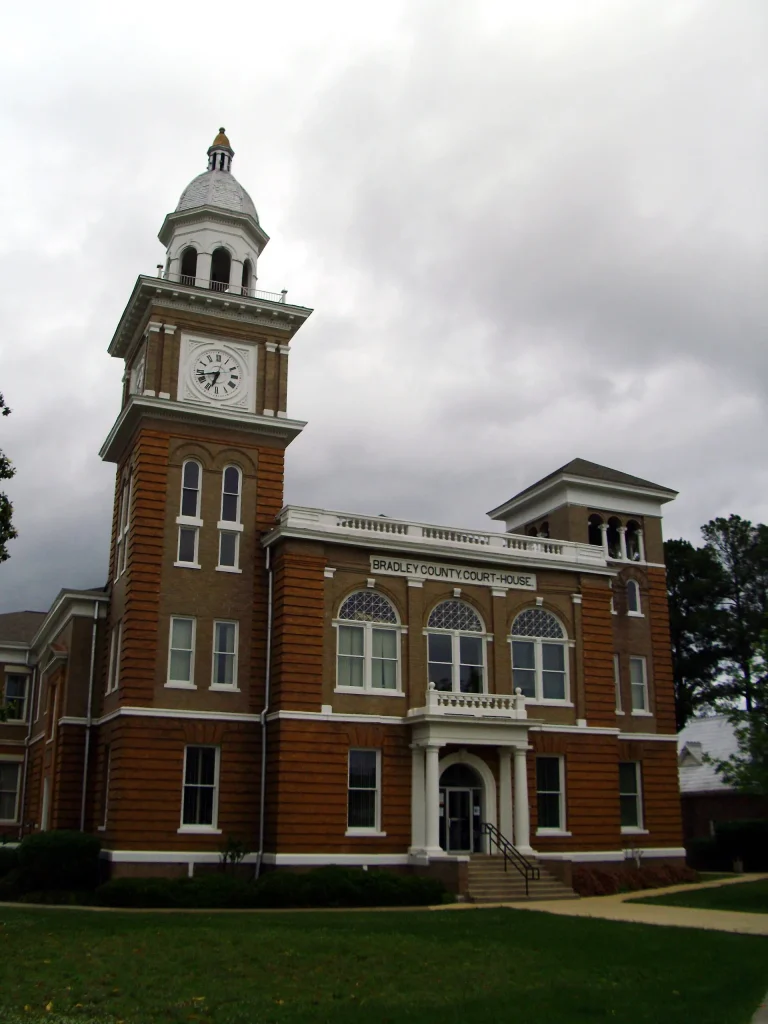
Bradley County Courthouse, built in 1903. Photo: Brandonrush, Wikimedia Commons, May 14, 2014. CC BY-SA 3.0. Source 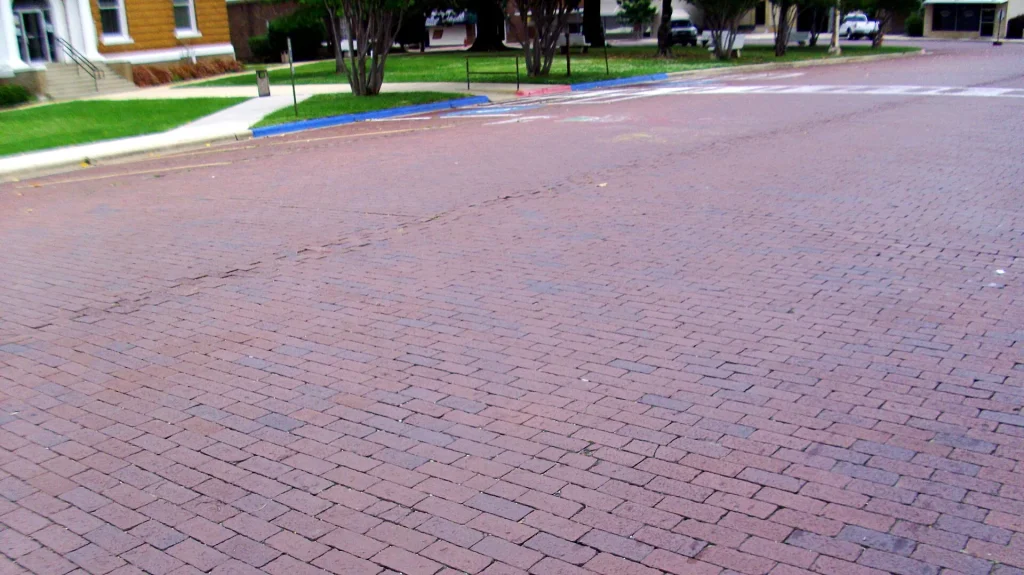
Brick streets in front of the courthouse, laid around 1927. Photo: Brandonrush, Wikimedia Commons, May 14, 2014. CC BY-SA 3.0. Source 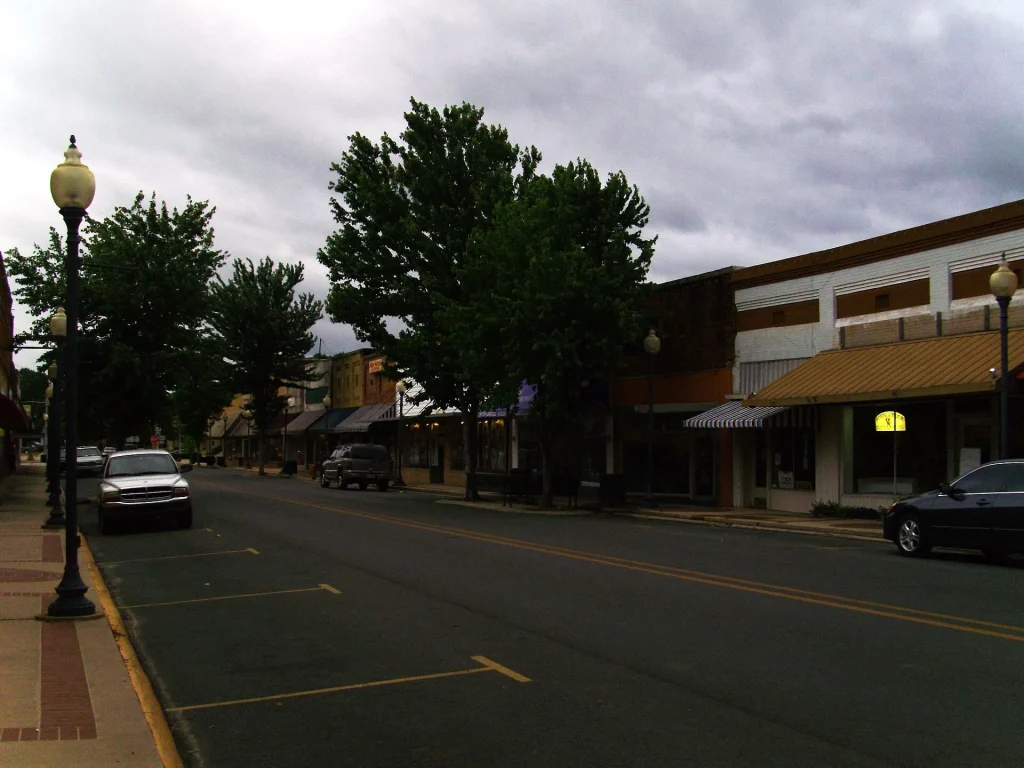
Downtown Warren, part of the Warren Commercial Historic District. Photo: Brandonrush, Wikimedia Commons, May 14, 2014. CC BY-SA 3.0. Source 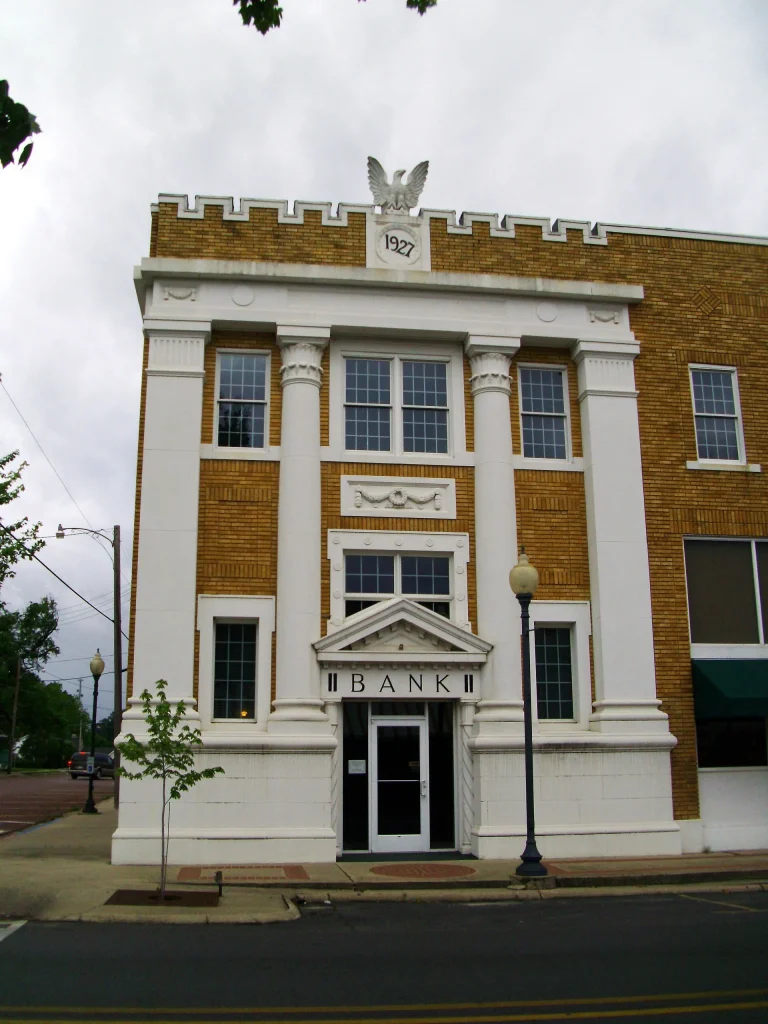
A bank building in downtown Warren. Photo: Brandonrush, Wikimedia Commons, May 14, 2014. CC BY-SA 3.0. Source 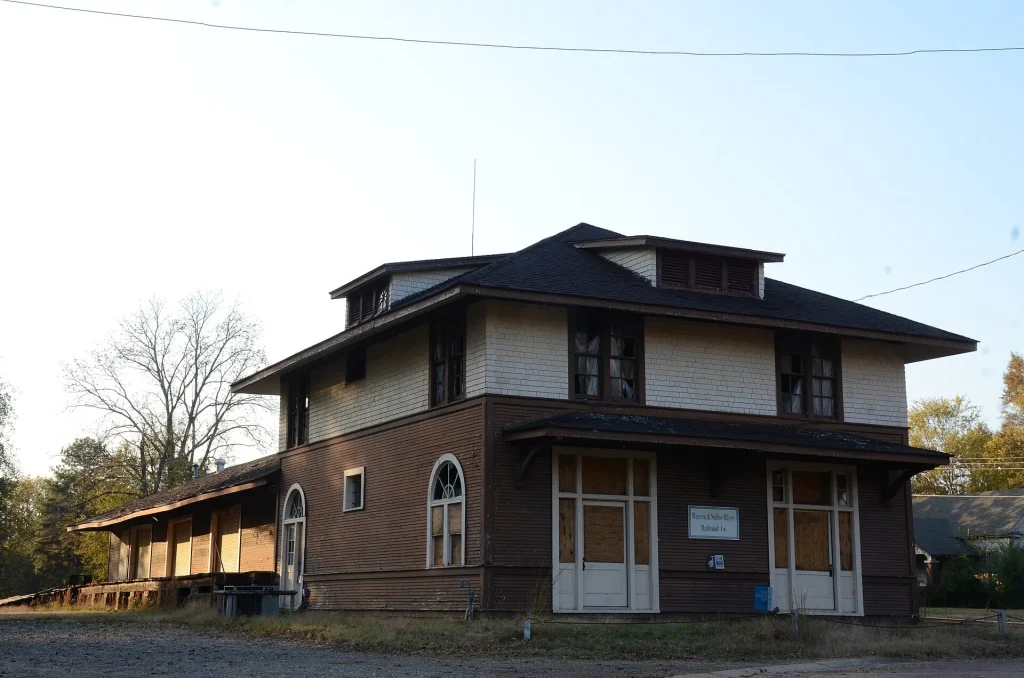
The Warren and Ouachita Valley Railway Station on West Cedar Street. Photo: Valis55, Wikimedia Commons, Nov. 25, 2016. CC BY-SA 4.0. Source 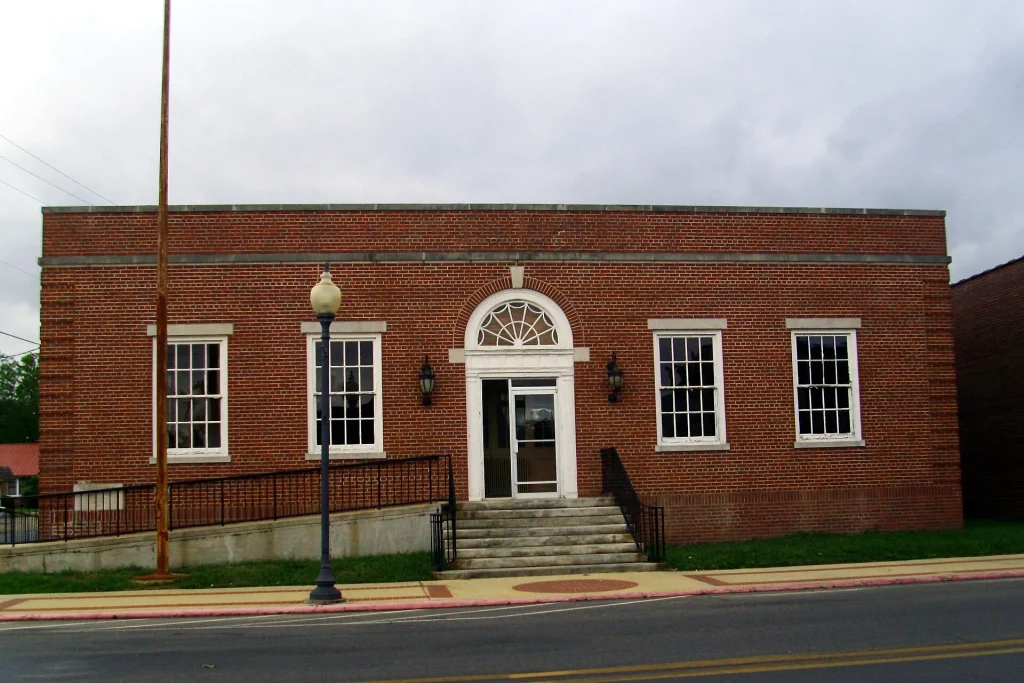
Warren Post Office, 236 S. Main St. Photo: Brandonrush, Wikimedia Commons, May 14, 2014. CC BY-SA 3.0. Source 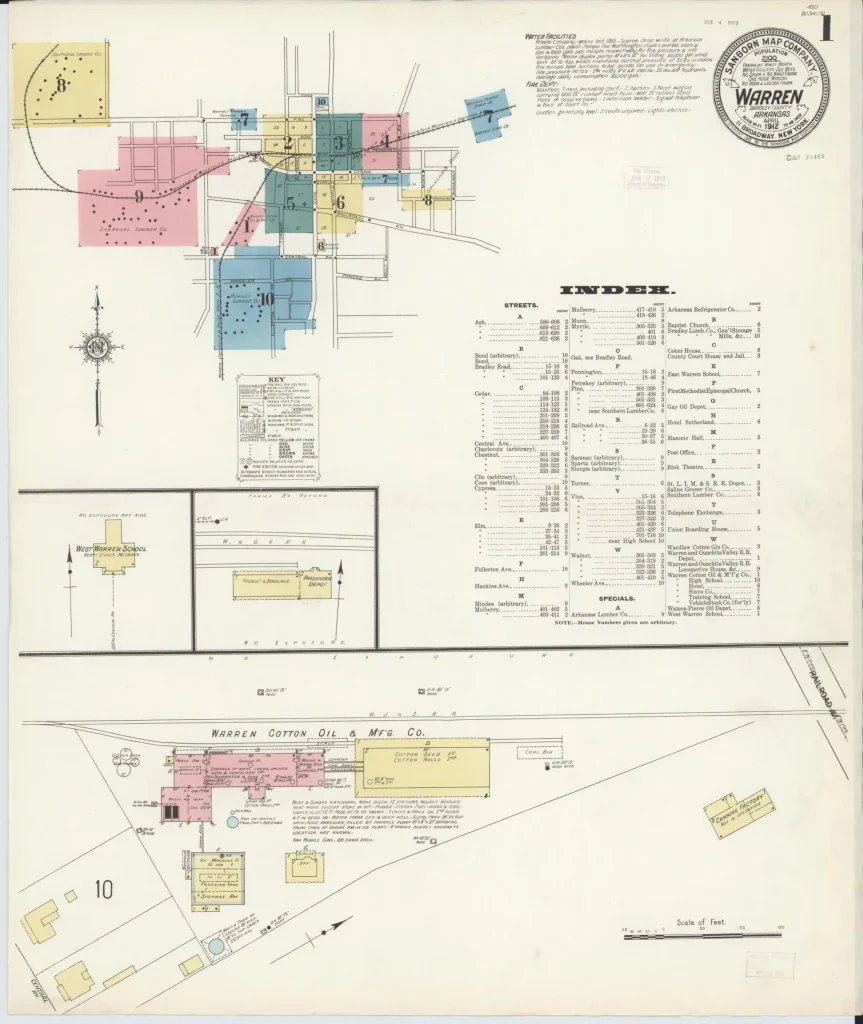
Sheet 1 of the April 1912 Sanborn fire insurance map of Warren (10 sheets). Photo: Library of Congress, Geography and Map Division, Sanborn Maps Collection, April 1912. Public domain (per Library of Congress). Source 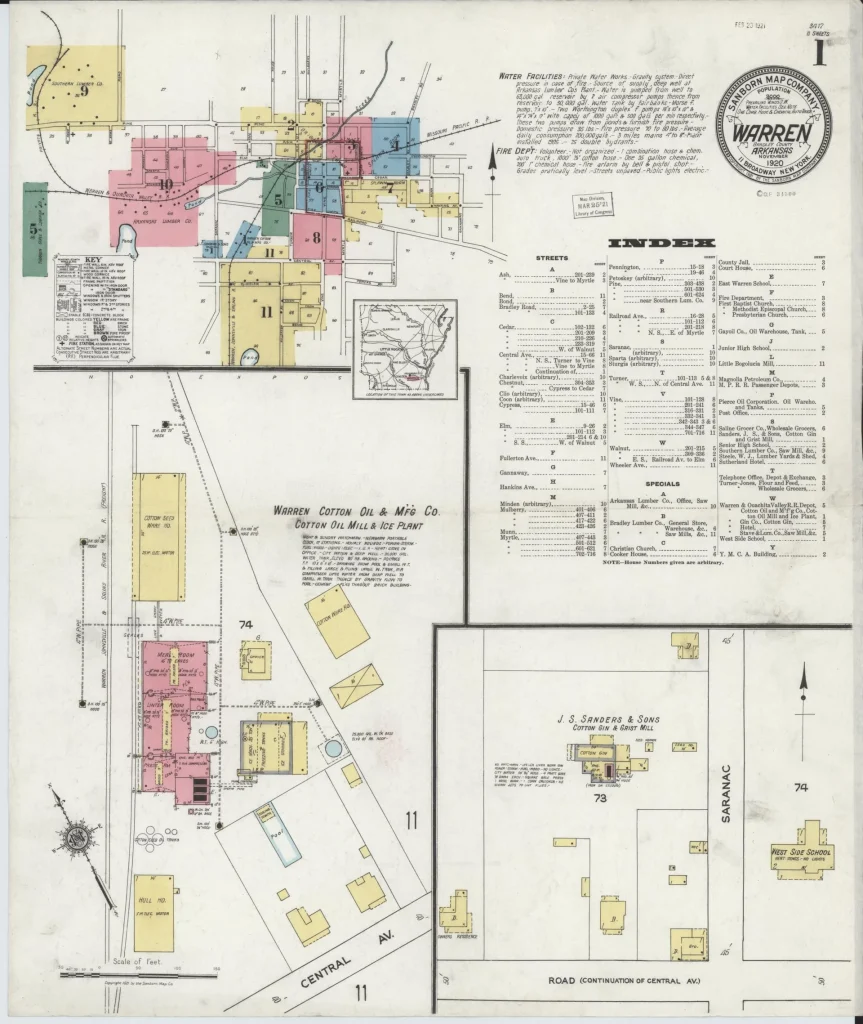
Sheet 1 of the November 1920 Sanborn fire insurance map of Warren (11 sheets). Photo: Library of Congress, Geography and Map Division, Sanborn Maps Collection, November 1920. Public domain (per Library of Congress). Source


Sources
- Bradley County Courthouse and Clerk's Office, National Register nomination (1976), Arkansas Historic Preservation Program. Accessed .
- Warren Commercial Historic District, National Register nomination (2016), National Park Service, NPGallery. Accessed .
- Warren Brick Streets (NRIS 06001277), National Park Service, NPGallery. Accessed .
- Warren (Bradley County), Encyclopedia of Arkansas. Accessed .
- Lynching in America: county data supplement (updated November 2024), Equal Justice Initiative. Accessed .
- Sanborn Fire Insurance Map from Warren, Bradley County, Arkansas, May 1907, Library of Congress. Accessed .
- Y.M.C.A., Warren, Ark. (Tichnor Brothers postcard #82473), Boston Public Library, via Digital Commonwealth. Accessed .
- Biographical and Historical Memoirs of Southern Arkansas, vol. 2 (Goodspeed Publishing, 1890), Internet Archive. Accessed .
- Arkansas: A Guide to the State (Writers' Program of the Work Projects Administration, 1941), Internet Archive. Accessed .