Lake Village sits on the western shore of Lake Chicot, which the town’s National Register nomination calls the largest oxbow lake in the United States. Chicot County was formed in 1823, and its government moved several times, twice because the Mississippi River swallowed the county seat, before settling in Lake Village in 1857. The land for the original downtown was donated by John Drennan and John Sumner. Sources differ on when the town was incorporated: its National Register nomination gives 1857, while the Encyclopedia of Arkansas gives Feb. 7, 1898.
The railroad arrived in 1903, and the town grew as a Delta cotton center and a destination for fishing and hunting. This page collects dated maps, photos and public records from that history, with a link to every source.
Maps through the years
Sanborn fire insurance maps show Lake Village building by building: pink for brick, yellow for frame. Here is the first sheet of each edition in the Library of Congress collection, from 1908 to 1917, followed by a recent photo. Swipe or scroll sideways to see them all, and select a map to open it full size.
June 1908

June 1912

August 1917

Now, 2014


Business and industry
- Newspapers: The Chicot Press, which Goodspeed calls the first newspaper venture in Chicot County, was first issued at Lake Village in the fall of 1860 by J. C. C. Bayne. Goodspeed, Biographical and Historical Memoirs of Southern Arkansas (1890)
- Railroads: In 1890 Goodspeed reported that the Arkansas & Gulf Railroad was being surveyed from the Arkansas River to the Louisiana line by way of Arkansas City and Lake Village. Goodspeed, Biographical and Historical Memoirs of Southern Arkansas (1890)
- Gins, staves and fish: The 1941 WPA guide said cotton gins, barrel-stave mills and commercial catching of buffalo and other “rough fish” provided the town’s income, and that Lake Village had long been a resort for fishing, boating and hunting. Arkansas: A Guide to the State (Writers' Program, WPA, 1941)
Landmarks
- Carlton House, 434 S. Lakeshore Dr.: Listed in 1991 for local-level significance in architecture, this building is recorded by the NPS with Colonial Revival styling, design or construction credited to Albert G. Simms and a period of significance of 1900-1924. National Park Service
- New Hope Missionary Baptist Church Cemetery, Historic Section, St. Marys St.: Listed in 1992 for local-level significance in black, this site is recorded by the NPS with a period of significance of 1900-1924, 1875-1899, 1850-1874 and 1925-1949 (nominated under the Ethnic and Racial Minority Settlement of the Arkansas Delta MPS). National Park Service
- Sam Epstein House, 488 Lake Shore Dr.: Listed in 1992 for local-level significance in community planning and development, commerce and european, this building is recorded by the NPS with Colonial Revival and Bungalow/Craftsman styling and a period of significance of 1900-1924 and 1925-1949 (nominated under the Ethnic and Racial Minority Settlement of the Arkansas Delta MPS). National Park Service
- John Tushek Building, 108 Main St.: Listed in 1993 for local-level significance in architecture, this building is recorded by the NPS with Beaux Arts styling and key year 1906. National Park Service
- Lake Village Confederate Monument, Lakeshore Dr. median, between Main and Jackson Sts.: Listed in 1996 for state-level significance in social history, this object is recorded by the NPS with Classical Revival styling and key year 1910 (nominated under the Civil War Commemorative Sculpture MPS). National Park Service
- Lake Village Post Office, 206 S. Cokley St.: Listed in 1998 for state-level significance in politics/government, this building is recorded by the NPS with Colonial Revival styling, design or construction credited to Avery Johnson and Louis A. Simon and key years 1938 and 1941 (nominated under the Post Offices with Section Art in Arkansas MPS). National Park Service
- Dr. E.P. McGehee Infirmary, 614 S. Cokley St.: Listed in 2005 for local-level significance in health/medicine, this building is recorded by the NPS with Colonial Revival and Bungalow/Craftsman styling, design or construction credited to Dr. Edward Pelham McGehee and key years 1910 and 1955. National Park Service
- Chicot County Courthouse, 108 Main St.: Listed in 2006 for local-level significance in politics/government and architecture, this building is recorded by the NPS with Art Deco styling and key year 1956. National Park Service
- Lake Village Commercial Historic District, Roughly bounded by Lakeshore Dr, Jackson St, Chicot St, and Church St: Listed in 2011 for local-level significance in architecture and landscape architecture, this district is recorded by the NPS with Italianate and Classical Revival styling, design or construction credited to Herman Voelker and Louis A. Simon and key years 1938 and 1956. National Park Service
Notable people
- Daniel Reynolds: Confederate general and state senator who lived in Lake Village. Encyclopedia of Arkansas
- Sam Epstein: Civic leader who lived in Lake Village; his house is on the National Register. Encyclopedia of Arkansas
- Claude Lightfoot: Communist Party activist, born in Lake Village. Encyclopedia of Arkansas
- Richard Cornelius Caesar: One of the Tuskegee Airmen, born in Lake Village. Encyclopedia of Arkansas
- Samuel Dunn Robinson: Arkansas Supreme Court justice who grew up in Lake Village. Encyclopedia of Arkansas
- Lamar McHan: Football player the Encyclopedia of Arkansas calls a star of the Canadian Football League; born and raised in Lake Village. Encyclopedia of Arkansas
Last checked Oct. 18, 2026.
Key facts
- Lake Village has been Chicot County's fourth county seat since 1857. (Source: National Register nomination, Lake Village Commercial Historic District)
- A 1923 newspaper report quoted in the town's National Register nomination called Chicot County "the richest county in the world so far as the production of cotton per acre is concerned." (Source: National Register nomination, Lake Village Commercial Historic District)
- Peel's Mill, north of downtown in the 1920s, was reported to be the largest hoop mill in the world, according to the nomination. (Source: National Register nomination, Lake Village Commercial Historic District)
- Lake Village's incorporation date differs by source: the National Register nomination says 1857, and the Encyclopedia of Arkansas says Feb. 7, 1898. (Source: National Register nomination; Encyclopedia of Arkansas)
- The Equal Justice Initiative documents 3 racial terror lynchings of Black people in Chicot County between 1877 and 1950. EJI counts only cases it could document, so the figure is a minimum. (Source: Equal Justice Initiative, Lynching in America county data (updated November 2024))
- In 1941 the WPA guide said cotton gins, barrel-stave mills and commercial "rough fish" catching provided Lake Village's income. (Source: Arkansas: A Guide to the State (Writers' Program, WPA, 1941))
Timeline
Chicot County is formed
The Arkansas Territorial Legislature creates Chicot County. Its first seat is Villemont, on the Mississippi River.
Villemont washes away
By 1847 the river has washed away the last of Villemont, and the county seat moves to Columbia, a few miles downriver.
Lake Village becomes the county seat
After Columbia is threatened by the river and a short stay at Masona on Bayou Macon, county government moves to Lake Village.
New Hope Missionary Baptist Church
Jim Kelley, then enslaved, founds New Hope Missionary Baptist Church, one of the oldest Black churches in Arkansas.
The Chicot Press
J. C. C. Bayne first issues the Chicot Press at Lake Village in the fall. Goodspeed calls it the county's first newspaper venture.
Federal troops in town
About 10,000 Federal troops occupy Lake Village after the Battle of Ditch Bayou below the town, according to the WPA guide.
Press dumped in the lake
Federal troops gut the Chicot Press office and dump its type and presses into Lake Chicot, about the time of the fighting at Ditch Bayou, according to Goodspeed.
Chicot Press suspends
The Chicot Press, by then published from Luna Landing, suspends for good.
Railroad survey
The Arkansas & Gulf Railroad is being surveyed via Arkansas City and Lake Village, according to Goodspeed.
A new Chicot Press
George C. Shell begins publishing a new Chicot Press at Lake Village, a four-page weekly.
First mayor
Lake Village elects its first mayor.
The railroad arrives
The Memphis, Helena and Louisiana Railroad reaches town, and its depot anchors the west end of Main Street, six blocks from the lake.
Tushek Building
John Tushek, an immigrant from Eastern Europe, builds a two-story building on Main Street for his store.
Main Street is paved
Main Street is paved and the city's first sewer system is installed. The Lakeshore Hotel opens the same year.
U.S. 65
U.S. Highway 65, which the nomination calls the first U.S. highway in Arkansas, is routed along Lakeshore Drive.
Lindbergh lands
A young Charles Lindbergh makes a forced landing at the Lake Village Country Club golf course in April. That night he takes a 30-minute moonlit flight over the town and the Mississippi River, which the town's National Register nomination calls the first recorded night flight over Lake Village.
Post office mural
Avery Johnson's mural Lake Country Wild Life, paid for by the U.S. Treasury Department's Section of Fine Arts, is painted for the post office.
Downtown joins the National Register
The Lake Village Commercial Historic District is listed on the National Register.
Photos

Index sheet of the June 1908 Sanborn fire insurance map of Lake Village. Photo: Library of Congress, Geography and Map Division, Sanborn Maps Collection, June 1908. Public domain (per Library of Congress). Source 
Chicot County Courthouse, 108 Main St. Photo: Brandonrush, Wikimedia Commons, Jan. 1, 2014. CC BY-SA 3.0. Source 
Lake Village Post Office, 206 S. Cokley St. Inside is Avery Johnson's 1941 mural, Lake Country Wild Life. Photo: Brandonrush, Wikimedia Commons, Jan. 1, 2014. CC BY-SA 3.0. Source 
The John Tushek Building, built in 1906 for John Tushek's store. Photo: Brandonrush, Wikimedia Commons, Jan. 1, 2014. CC BY-SA 3.0. Source 
Storefronts in the Lake Village Commercial Historic District. Photo: Brandonrush, Wikimedia Commons, Jan. 1, 2014. CC BY-SA 3.0. Source 
Dr. E. P. McGehee Infirmary, 614 S. Cokley St. Its National Register record gives key years of 1910 and 1955. Photo: Valis55, Wikimedia Commons, March 25, 2016. CC BY-SA 3.0. Source 
Carlton House, 434 S. Lakeshore Dr. Photo: Brandonrush, Wikimedia Commons, Jan. 1, 2014. CC BY-SA 3.0. Source 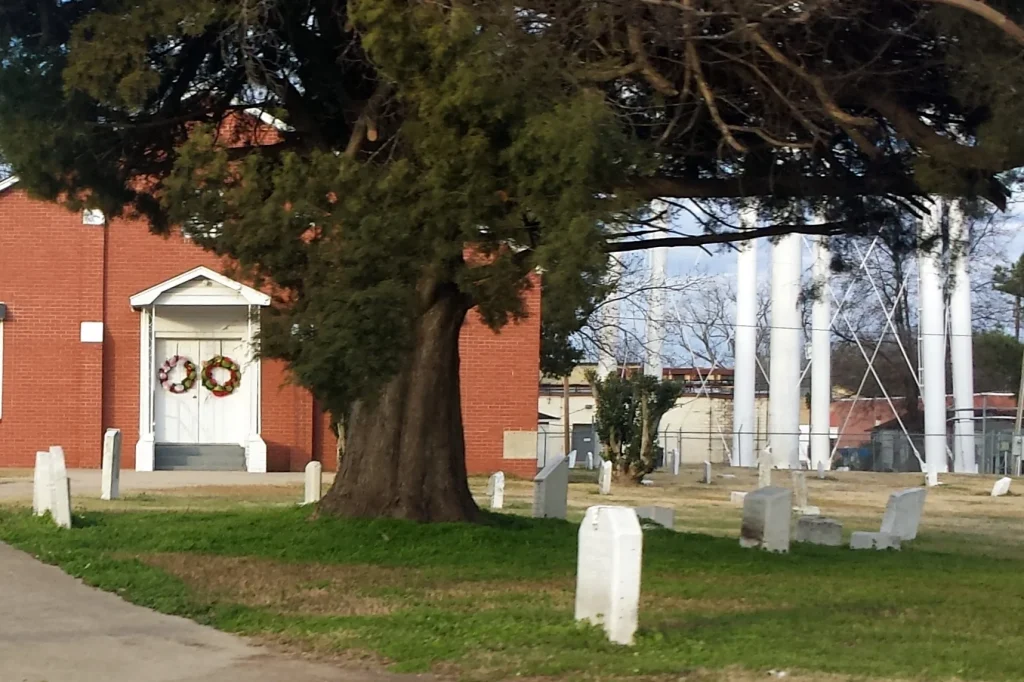
The historic section of New Hope Missionary Baptist Church Cemetery. Photo: Brandonrush, Wikimedia Commons, Jan. 1, 2014. CC BY-SA 3.0. Source Sheet 1 of the June 1912 Sanborn fire insurance map of Lake Village (3 sheets). Photo: Library of Congress, Geography and Map Division, Sanborn Maps Collection, June 1912. Public domain (per Library of Congress). Source 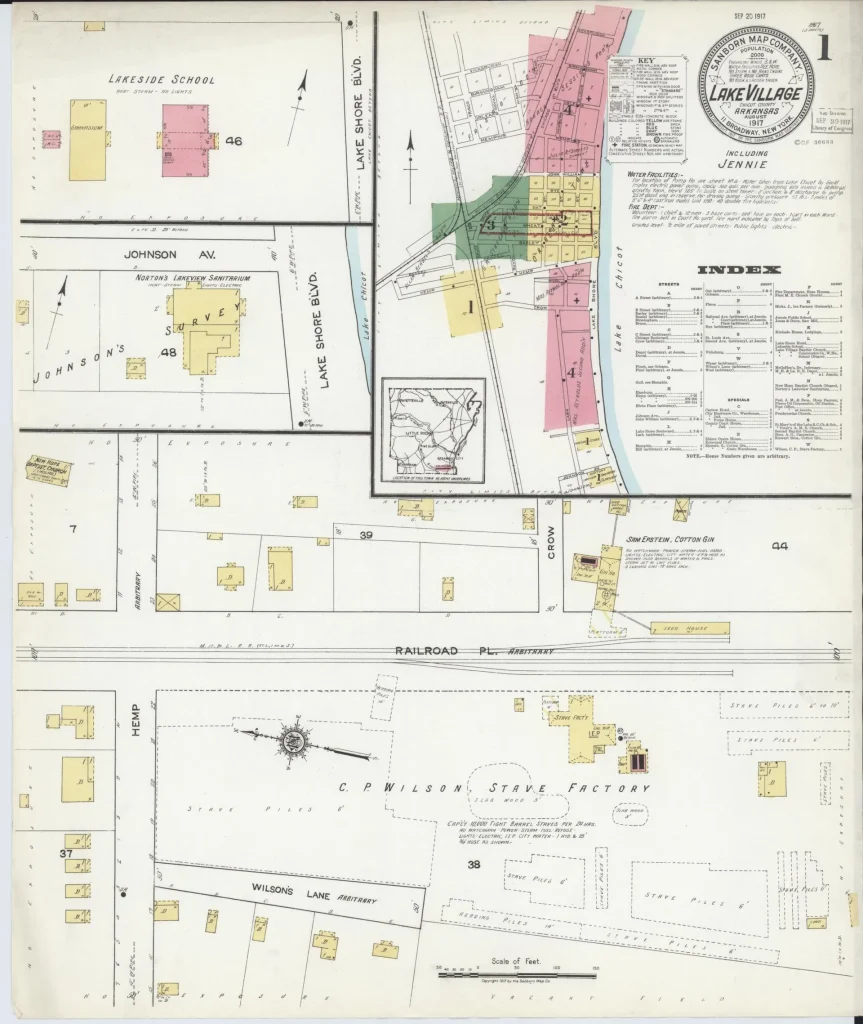
Sheet 1 of the August 1917 Sanborn fire insurance map of Lake Village (5 sheets). Photo: Library of Congress, Geography and Map Division, Sanborn Maps Collection, August 1917. Public domain (per Library of Congress). Source


Sources
- Lake Village Commercial Historic District, National Register nomination (2011), National Park Service, NPGallery. Accessed .
- Chicot County Courthouse (NRIS 05001592), National Park Service, NPGallery. Accessed .
- Lake Village (Chicot County), Encyclopedia of Arkansas. Accessed .
- Lynching in America: county data supplement (updated November 2024), Equal Justice Initiative. Accessed .
- Sanborn Fire Insurance Map from Lake Village, Chicot County, Arkansas, June 1908, Library of Congress. Accessed .
- Biographical and Historical Memoirs of Southern Arkansas, vol. 2 (Goodspeed Publishing, 1890), Internet Archive. Accessed .
- Arkansas: A Guide to the State (Writers' Program of the Work Projects Administration, 1941), Internet Archive. Accessed .