Crossett was founded as a company town to house a sawmill and the Crossett Lumber Company. Most of the company’s leadership and money came from three families, and its first mill manager and co-owner, E. W. “Cap” Gates, is credited as the visionary behind the town. For decades it was a company town: people worked for the company, lived in company houses, shopped at the company store and were paid in company scrip.
That began to change in 1946, when the company started selling homes to its employees. In 1940 Crossett became the first planned city in Arkansas, according to its National Register nomination. This page collects dated maps, postcards, photos and public records from that history, with a link to every source.
Maps through the years
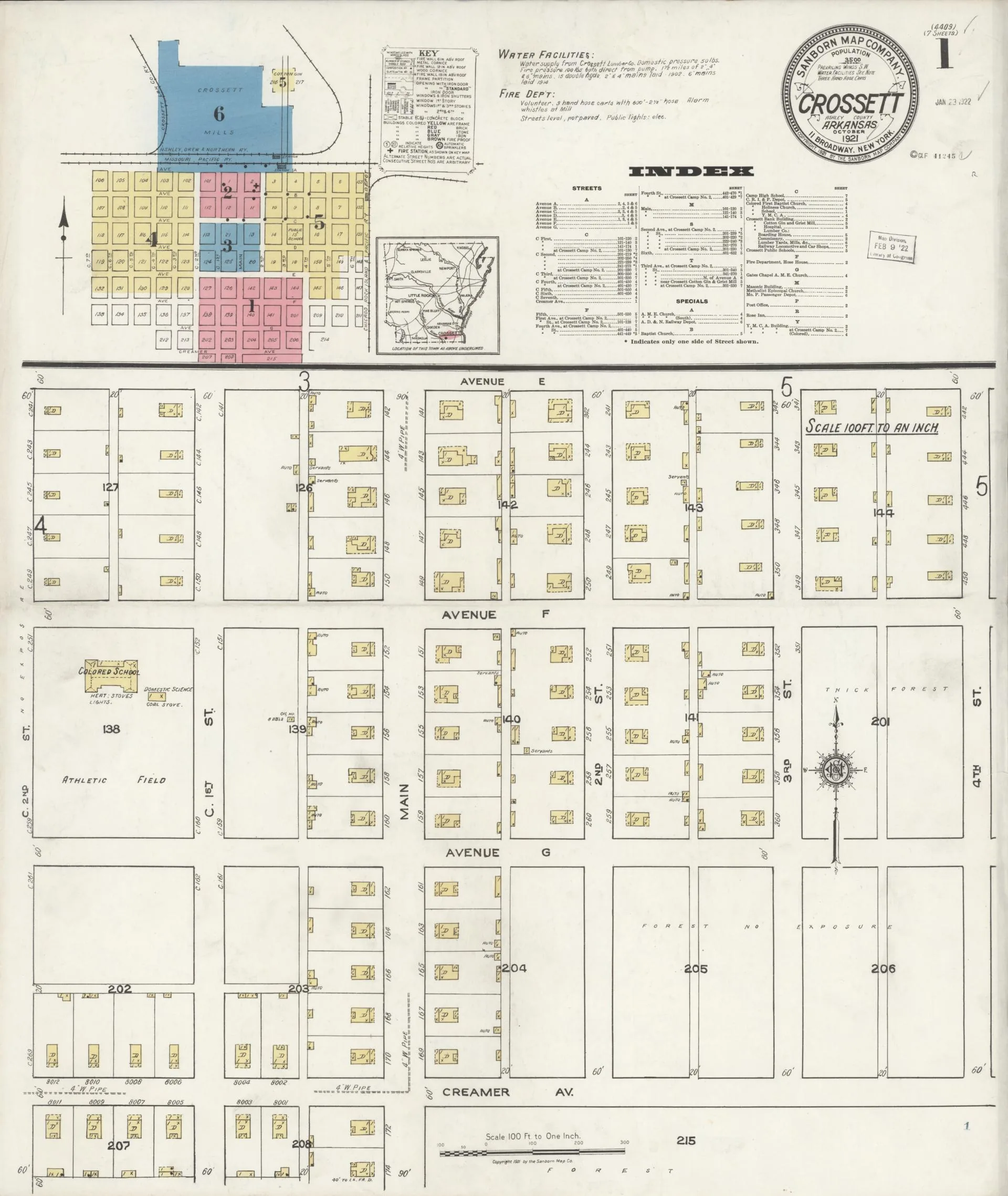
Sanborn fire insurance maps show Crossett building by building: pink for brick, yellow for frame. Here is the first sheet of each edition in the Library of Congress collection, from 1908 to 1921, followed by a recent photo. Swipe or scroll sideways to see them all, and select a map to open it full size.
June 1908

May 1914

October 1921
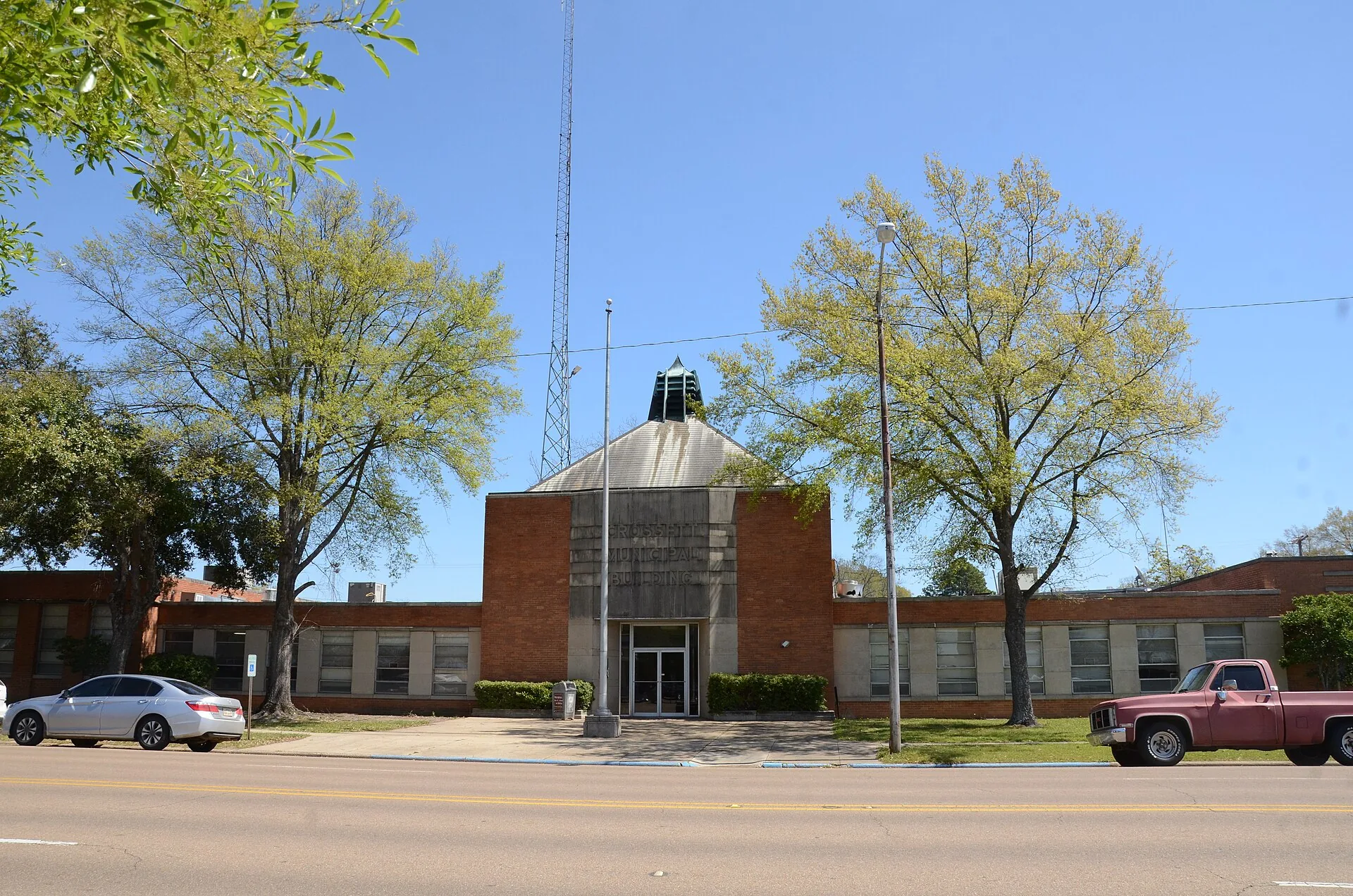
Now, 2016

Business and industry
- Seed trees: In 1926 and early 1927 company forester W. K. Williams, over considerable opposition, got the Crossett company to start leaving pine seed trees, called “mammy trees” by the saw crews, as the virgin timber was cut, according to Forest Service researcher R. R. Reynolds. USDA Forest Service, The Crossett Story
- The company town: Reynolds recalled that in the mid-1930s the company owned all the land in town and about 2 square miles around it. One company store took coupon books against wages, so private businesses had to locate outside the company land, giving rise to North, West and South Crossett. USDA Forest Service, The Crossett Story
- Pulp, paper and chemicals: Pulp and paper mills were built at Crossett in 1937 to use small trees from thinning and the tops of sawlog trees, according to Reynolds. The 1941 WPA guide said the whole town was owned by the Crossett Lumber Company, whose mill turned out “a hundred million board feet of pine a year,” with a chemical plant making charcoal, alcohol, acids and oils from by-products. Arkansas: A Guide to the State (Writers' Program, WPA, 1941)
- 1935 strike: After the National Recovery Act was struck down in 1935, a short strike involving 600 Crossett workers was broken and its leaders dismissed, according to the WPA guide. Arkansas: A Guide to the State (Writers' Program, WPA, 1941)
Landmarks
- Crossett Experimental Forest Building No. 2, AR 133 S of Crossett: Listed in 1993 for local-level significance in conservation and social history, this building is recorded by the NPS with Bungalow/Craftsman styling, design or construction credited to Civilian Conservation Corps and key year 1939 (nominated under the Facilities Constructed by the CCC in Arkansas MPS). National Park Service
- Crossett Experimental Forest Building No. 6, AR 133 S of Crossett: Listed in 1993 for local-level significance in conservation and social history, this building is recorded by the NPS with Bungalow/Craftsman styling, design or construction credited to Civilian Conservation Corps and key year 1940 (nominated under the Facilities Constructed by the CCC in Arkansas MPS). National Park Service
- Crossett Experimental Forest Building No. 8, AR 133 S of Crossett: Listed in 1993 for local-level significance in conservation and social history, this building is recorded by the NPS with Bungalow/Craftsman styling, design or construction credited to Civilian Conservation Corps and key year 1940 (nominated under the Facilities Constructed by the CCC in Arkansas MPS). National Park Service
- Crossett Post Office, 125 Main St.: Listed in 2003 for state-level significance in architecture, politics/government and education, this building is recorded by the NPS with International Style and Greek Revival styling, design or construction credited to Federal Works Agency and Boyd, J.O. Construction Co. and key year 1939. National Park Service
- Crossett Municipal Auditorium, 1100 Main St.: Listed in 2007 for local-level significance in community planning and development, politics/government and architecture, this building is recorded by the NPS with Moderne styling, design or construction credited to Clippard & Phelps Trapp and Vollmer, C.W. & Co. and key years 1953 and 1957. National Park Service
- Crossett Municipal Building, 307-309 Main St.: Listed in 2007 for local-level significance in community planning and development, politics/government and architecture, this building is recorded by the NPS with Art Deco styling, design or construction credited to Clippard & Phelps Trapp and Vollmer, C.W. & Co. and key years 1953 and 1957. National Park Service
- Crossett Methodist Church, 500 Main St.: Listed in 2010 for local-level significance in architecture and landscape architecture, this building is recorded by the NPS with Late Gothic Revival and Tudor Revival styling, design or construction credited to John Parks Almand and Clippord & Phelps Trapp and key years 1949 and 1959. National Park Service
- Edward C. Crossett Youth Center, 300 North Dr. Martin Luther King Jr. Dr.: Listed in 2024 for local-level significance in entertainment/recreation and ethnic heritage-black, this building has no style, architect or key date in the NPS index record. National Park Service
Notable people
- Napoleon Bonaparte (Nap) Murphy: Longtime state legislator, born in Crossett. Encyclopedia of Arkansas
- Gretha Boston: Won a 1995 Tony Award for playing Queenie in the Broadway revival of Show Boat. The Encyclopedia of Arkansas lists her among Crossett’s famous residents. Encyclopedia of Arkansas
- Barry Switzer: Former University of Oklahoma football coach, inducted into the College Football Hall of Fame in 2001. Listed among Crossett’s famous residents. Encyclopedia of Arkansas
- Carolyn Moffatt: Women’s basketball coach, inducted into the Arkansas Sports Hall of Fame in 2011. Listed among Crossett’s famous residents. Encyclopedia of Arkansas
- K. T. Oslin: Country music star who became famous in the 1980s. Listed among Crossett’s famous residents. Encyclopedia of Arkansas
- Jim Johnson: Served a term on the Arkansas Supreme Court and was the Democratic nominee for governor in 1966; the Encyclopedia of Arkansas describes him as a segregationist. Listed among Crossett’s famous residents. Encyclopedia of Arkansas
- Scottie Pippen: Born in Hamburg, the Ashley County seat, in 1965; six-time NBA champion, inducted into the Naismith Basketball Hall of Fame in 2010. Naismith Basketball Hall of Fame
Last checked Oct. 18, 2026.
Key facts
- Until 1946, the Crossett company owned every business and building in town except a café, a pressing shop and the post office. (Source: National Register nomination, Crossett Municipal Building)
- In 1892, E. S. Crossett, C. W. Gates and J. W. Watzek bought the Fordyce Lumber Company; it became part of a corporation that included the Crossett Lumber Company. (Source: National Register nomination, Fordyce Commercial Historic District)
- In 1953 Crossett was the only U.S. city under 100,000 people with a comprehensive city plan covering all community facilities, according to its National Register nomination. (Source: National Register nomination, Crossett Municipal Building)
- The Equal Justice Initiative documents 10 racial terror lynchings of Black people in Ashley County between 1877 and 1950. EJI counts only cases it could document, so the figure is a minimum. (Source: Equal Justice Initiative, Lynching in America county data (updated November 2024))
- In 1941 the WPA guide reported that the Crossett Lumber Company mill turned out about 100 million board feet of pine a year. (Source: Arkansas: A Guide to the State (Writers' Program, WPA, 1941))
Timeline
Sanborn map of Crossett
The Sanborn Map Company draws a fire insurance map of Crossett in June 1908 (see the photos below).
1926–1927
"Mammy trees"
Company forester W. K. Williams gets the Crossett company to start leaving pine seed trees as the virgin timber is cut, according to R. R. Reynolds of the Forest Service.
First sizable pine plantation
Part of the company's old cattle farm east of Crossett is planted with pine. Reynolds calls it the first sizable loblolly pine plantation in the area.
A new company forester
A. E. (Wack) Wackerman, a forestry graduate of the University of Minnesota and Yale, replaces Williams as Crossett Lumber Company forester. He serves until 1932.
Searching for a research forest
After the company offers the Forest Service about three sections of second-growth timberland, R. R. Reynolds begins looking over company land for a proposed experimental forest.
Roads dug by hand
Relief workers build the experimental forest's first roads by hand, paid $1.25 a day for a four-day week, according to Reynolds.
Crossett Experimental Forest
The Crossett Lumber Company donates 1,680 acres to the U.S. Forest Service for the Crossett Experimental Forest, where researchers study how to restore and manage second-growth loblolly and shortleaf pine.
Strike broken
A short strike involving 600 Crossett mill workers is broken and its leaders dismissed, according to the WPA guide.
WPA help for log buildings
A Works Progress Administration allotment lets the station hire carpenters and log builders for the forest's original log buildings.
Forester's Home is ready
The big log Forester's Home on the experimental forest is ready, and Reynolds and his wife, Geneva, move out of town.
Pulp and paper mills
Pulp and paper mills are built at Crossett to use small trees from thinning and the tops of sawlog trees, according to Reynolds.
First planned city in Arkansas
City planners prepare a plan for a future Crossett of 5,000 people, making it the first planned city in Arkansas, according to its National Register nomination.
A company-owned town
The WPA guide reports that the Crossett Lumber Company owns the entire town of 4,891 people and that each summer the senior class of the Yale School of Forestry comes for a six-week field course.
Farm Forestry Study Day
The first of a long series of annual Farm Forestry Study Days is held on the Crossett Experimental Forest with the Arkansas Extension Service and the Crossett Lumber Company.
Homes for sale
Until now the company has owned every business and building in town except a café, a pressing shop and the post office. A new development plan is adopted, and homes are sold to company employees.
Pine genetics research
A loblolly pine genetics research program begins at the Forest Service's Crossett branch. Reynolds calls it one of the first major genetics projects in the South.
Municipal building bond fails
Voters turn down a $200,000 bond issue for a municipal building by 35 votes.
"The City with a Plan"
Harland Bartholomew and Associates of St. Louis presents a plan for a future Crossett of 25,000 people, and Crossett is named one of 100 finalists in the All-America Cities contest. Citizens organize to pass the municipal building bond.
Georgia-Pacific buys the mill
Georgia-Pacific buys the assets of the Crossett Lumber Company, creating its Crossett Division, and begins making plywood from Southern yellow pine.
Experimental Forest buildings are listed
Three buildings at the U.S. Forest Service's Crossett Experimental Forest south of town are listed on the National Register.
Municipal Building and Auditorium are listed
The Crossett Municipal Building and Municipal Auditorium are listed on the National Register.
Photos

Index sheet of the June 1908 Sanborn fire insurance map of Crossett. Photo: Library of Congress, Geography and Map Division, Sanborn Maps Collection, June 1908. Public domain (per Library of Congress). Source 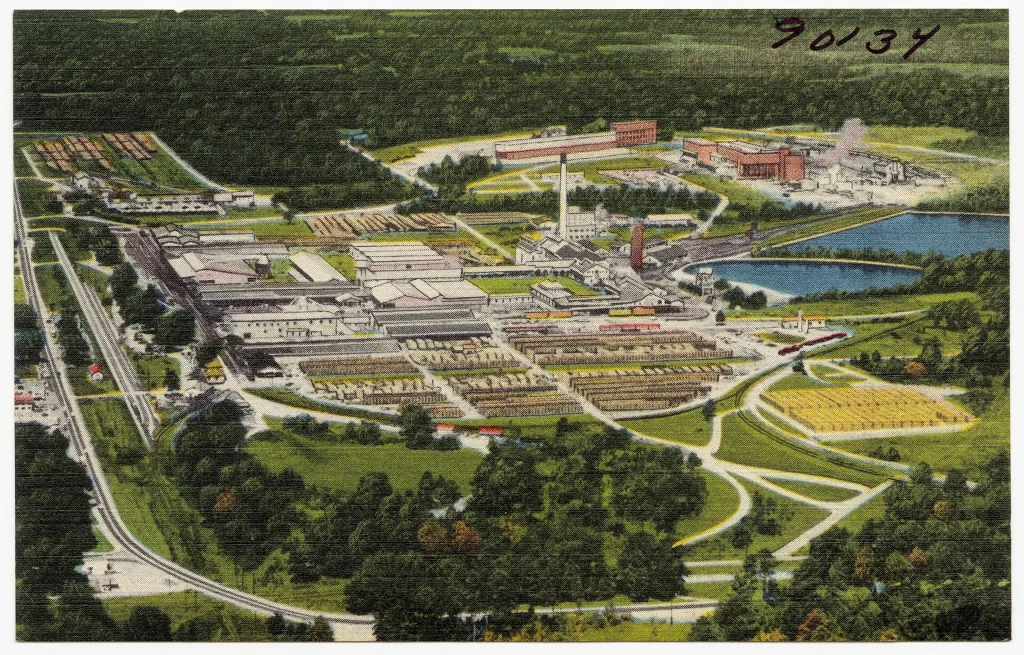
Postcard view of Crossett's mills. Photo: Tichnor Brothers postcard #90134, Boston Public Library, Tichnor Brothers Collection, c. 1930–1945. No known copyright restrictions (per Boston Public Library). Source 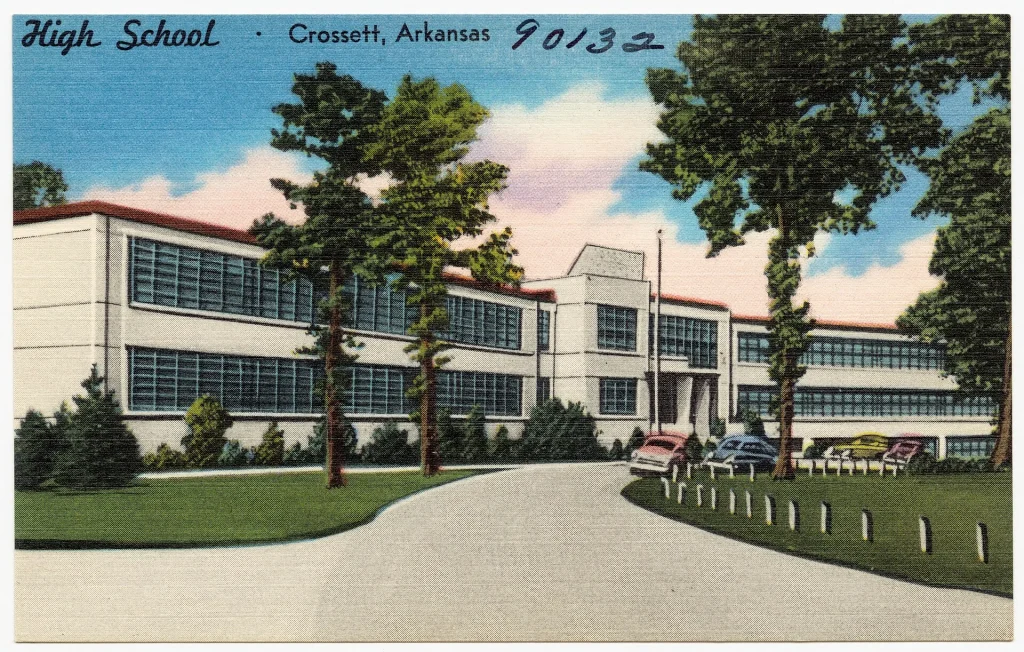
Postcard of the high school in Crossett. Photo: Tichnor Brothers postcard #90132, Boston Public Library, Tichnor Brothers Collection, c. 1930–1945. No known copyright restrictions (per Boston Public Library). Source 
Postcard of the Rose Inn and Lodge in Crossett. Photo: Tichnor Brothers postcard #90063, Boston Public Library, Tichnor Brothers Collection, c. 1930–1945. No known copyright restrictions (per Boston Public Library). Source 
Crossett Municipal Building, 307–309 Main St. Photo: Valis55, Wikimedia Commons, March 25, 2016. CC BY-SA 3.0. Source 
Crossett Post Office, 125 Main St. Photo: Tony Kelley, Wikimedia Commons, Nov. 19, 2012. CC BY-SA 3.0. Source 
Crossett Methodist Church, 500 Main St. Photo: Tony Kelley, Wikimedia Commons, Nov. 17, 2012. CC BY-SA 3.0. Source 
Crossett Municipal Auditorium, 1100 Main St. Photo: Tony Kelley, Wikimedia Commons, Nov. 17, 2012. CC BY-SA 3.0. Source 
Sawmill No. 1, its power plant, log pond and log ramp at the Crossett Lumber Company. The mill housed two high-speed band mills. The photo is undated. Photo: U.S. Forest Service, photo FS 394380, from R. R. Reynolds, The Crossett Story (USDA Forest Service General Technical Report SO-32, 1980), Date unknown. Public domain (U.S. government work). Source 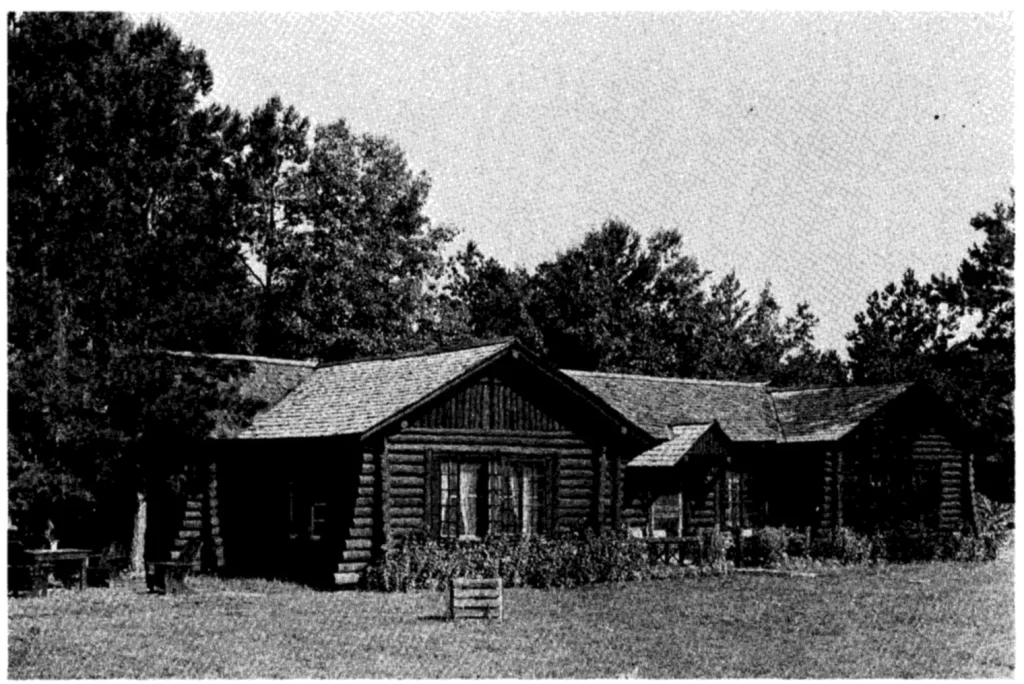
The completed Forester's Home on the Crossett Experimental Forest in 1937, a log house with a living room, dining room, kitchen, two bedrooms, a sleeping porch, a bath, a laundry room and a cellar. Photo: U.S. Forest Service, photo FS 350851, from R. R. Reynolds, The Crossett Story (USDA Forest Service General Technical Report SO-32, 1980), 1937. Public domain (U.S. government work). Source 
Sheet 1 of the May 1914 Sanborn fire insurance map of Crossett (6 sheets). Photo: Library of Congress, Geography and Map Division, Sanborn Maps Collection, May 1914. Public domain (per Library of Congress). Source 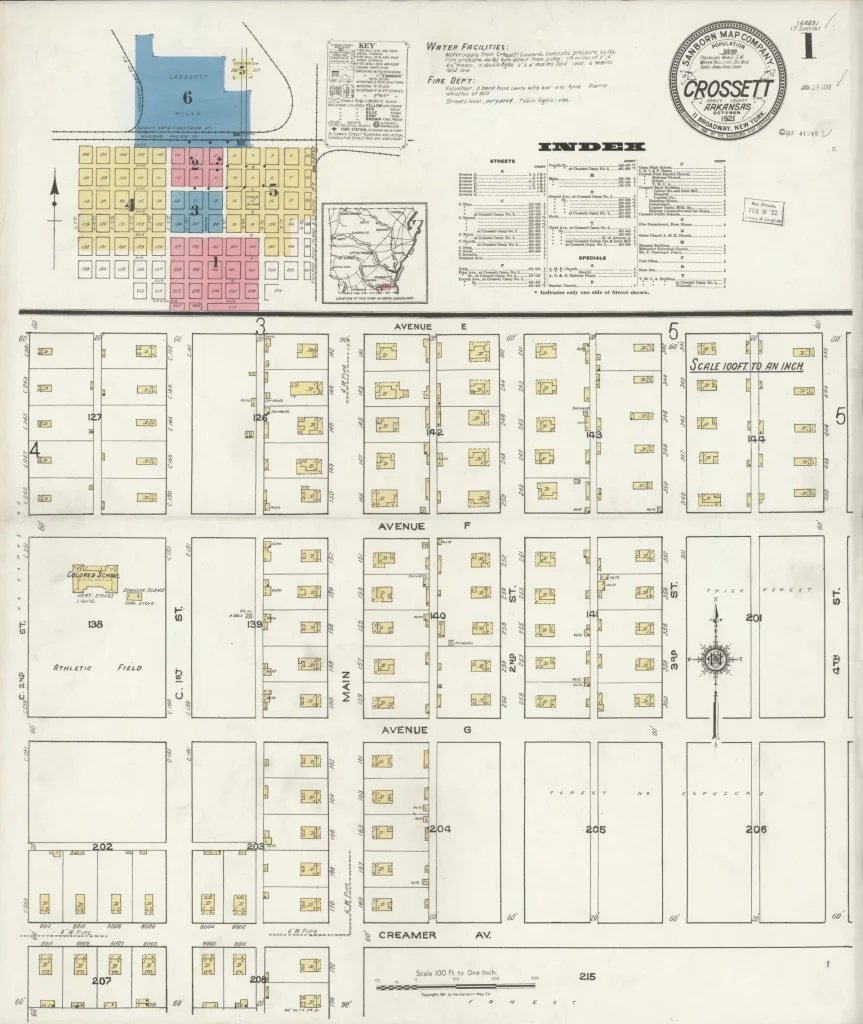
Sheet 1 of the October 1921 Sanborn fire insurance map of Crossett (7 sheets). Photo: Library of Congress, Geography and Map Division, Sanborn Maps Collection, October 1921. Public domain (per Library of Congress). Source


Sources
- Crossett Municipal Building, National Register nomination (2007), National Park Service, NPGallery. Accessed .
- Fordyce Commercial Historic District, National Register nomination (2008), National Park Service, NPGallery. Accessed .
- Crossett (Ashley County), Encyclopedia of Arkansas. Accessed .
- The Crossett Experimental Forest: 72 years of science delivery (Guldin, 2009), USDA Forest Service. Accessed .
- Lynching in America: county data supplement (updated November 2024), Equal Justice Initiative. Accessed .
- Sanborn Fire Insurance Map from Crossett, Ashley County, Arkansas, June 1908, Library of Congress. Accessed .
- Tichnor Brothers postcards #90132, #90134 and #90063, Boston Public Library, via Digital Commonwealth. Accessed .
- The Crossett Story: The Beginning of Forestry in Southern Arkansas and Northern Louisiana (R. R. Reynolds, General Technical Report SO-32, 1980), USDA Forest Service. Accessed .
- Arkansas: A Guide to the State (Writers' Program of the Work Projects Administration, 1941), Internet Archive. Accessed .